In short
- Honey is about 82% sugar, mostly fructose and glucose.
- It contains few vitamins and minerals, and they are not the reason to eat it.
- According to research, it really does ease children's coughs (over the age of 1).
- It counts as sugar, so it has to fit within your daily sugar limit.
- It must not be given to babies under 1.
What is in 100 grams of honey?
Honey is overwhelmingly sugar and water. According to the US Department of Agriculture's nutrient database (USDA FoodData Central), 100 g of honey contains 82 g of sugar, 17 g of water and just 0.3 g of protein, with no fat at all. It provides 304 kcal, so one heaped tablespoon (about 20 g) has roughly 60 kcal[1].
These are average values: the exact composition varies by honey type, year and region. Darker honeys (such as honeydew or chestnut honey) generally contain more minerals and more pigments than pale acacia honey.
The sugars in honey: why is it sweeter than sugar?
Table sugar (sucrose) is one molecule of glucose linked to one molecule of fructose. Bees use enzymes to break down most of the sucrose in flower nectar, so in honey the two sugars are present separately and very little sucrose remains[1].
- Fructose: the sweetest natural sugar, which is why less honey than sugar gives you the same sweetness.
- Glucose: this is what crystallises out of honey. The more glucose it contains relative to fructose, the faster honey turns creamy: that is why sunflower honey crystallises quickly and acacia honey stays liquid for a long time. (Read more: How to spot real honey from a producer)
- Effect on blood sugar: the glycaemic index of honey varies widely by type. Honeys rich in fructose (such as acacia) raise blood sugar more slowly, and those richer in glucose more quickly[2]. Honey is still sugar, though: for people with diabetes, it counts towards their carbohydrate allowance.
How much honey fits into a day?
The World Health Organization (WHO) recommends that added and "free" sugars make up less than 10% of daily energy intake, and ideally less than 5%. Honey explicitly belongs in this group, just like sugar and syrups[3].
~60 g
of honey is the upper limit (10%) on 2,000 kcal a day, if you eat no other sugar
~30 g
of honey is the ideal limit (5%): about one and a half tablespoons
In practice, this means honey is the best choice when it replaces sugar rather than being added on top of it: in your morning tea, in yoghurt or on pancakes, it is a much tastier and more aromatic sweetener than granulated sugar.
Vitamins and minerals: not much, but they are there
You often read that honey is "full of vitamins". Sadly, that is an exaggeration. Honey does contain many vitamins and minerals, but in very small amounts: one tablespoon of honey provides less than 1% of the daily reference intake for each of them[1][4].
So the reason to eat honey is not its vitamins, but its taste, its aroma and its natural origin. We get our vitamins and minerals from vegetables, fruit and whole grains.
What really makes honey special
Tables leave out the components that make honey more than a sweet syrup:
- Enzymes: added by the bees (such as diastase and glucose oxidase). Glucose oxidase produces small amounts of hydrogen peroxide, which also helps honey inhibit the growth of bacteria. Enzymes are sensitive to heat, which is why EU honey rules set a minimum diastase activity, which falls in overheated honey[5].
- Polyphenols and flavonoids: antioxidant compounds of plant origin. Their amounts vary widely by honey type, with more in darker honeys. They have a measurable antioxidant effect in the laboratory, but there is little evidence of what this means in the human body at normal levels of consumption[6].
- Low water content and acidity: this is why well-stored honey does not spoil, and why bacteria do not multiply in it.
Tip: to preserve the enzymes and aromas, stir honey into tea that is warm enough to drink rather than very hot.
What does the research say?
Below, we have sorted the most often mentioned effects by how strong the scientific evidence behind them is.
Strong evidence
Easing children's coughs (over the age of 1)
According to a Cochrane review, honey probably eases children's acute cough better than no treatment or a placebo. UK health guidance (NICE) also suggests honey for easing cough from a cold at home, for children over 1[7][8].
Strong evidence medical honey only
Wounds and burns
According to a Cochrane review, superficial burns treated with honey sterilised for medical use healed about 4–5 days faster than those treated with conventional dressings[9]. Important: this applies to medical honey dressings. Do not put kitchen honey on an open wound, and always let a doctor decide how to treat a wound.
Promising, but low certainty
Blood sugar and cholesterol
A 2022 meta-analysis of 18 controlled trials found that fasting blood sugar and cholesterol levels improved when honey was eaten as part of a healthy diet. The most favourable results were seen with acacia (robinia) honey, clover honey and unprocessed raw honey. The authors themselves stress that the certainty of the evidence is low and that more research is needed[10].
Shown in the laboratory
Antibacterial and antioxidant effects
Under laboratory conditions, honey inhibits the growth of many bacteria and contains antioxidant compounds[6]. It does not follow from this that eating honey cures or prevents infections.
No reliable human evidence
Gut flora, sleep, stress, memory
Honey contains small amounts of complex sugars that can feed gut bacteria, and there are animal experiments and small studies on its effects on the nervous system. There is currently no reliable evidence of whether these have a meaningful effect in humans[6].
Honey in folk tradition
From ancient Egypt to Hungarian peasant kitchens, honey has been used for a great many ailments: wounds, sore throats, coughs, digestive complaints, skin problems and as a tonic. These traditions show how highly it was valued, but modern science has not confirmed most of them. Where it has, we have noted it above.
In the European Union, only officially authorised health claims may be made about food, and there is currently no such authorised claim for honey[11]. So we do not claim that honey heals either. What we do claim is that it is delicious, natural and, when well chosen, a far better experience than sugar.
Who should take care?
- Babies under 1: honey must not be given to them in any form, because of the risk of infant botulism. Nébih, the Hungarian food safety authority, gives the same advice[12].
- People with diabetes: honey raises blood sugar too and has to be counted in the carbohydrate allowance. Talk to your doctor or dietitian about your diet.
- Teeth: like all sugary foods, honey encourages tooth decay, so it is a good idea to drink water or brush your teeth afterwards.
- People with pollen allergies: in rare cases, it can cause allergic symptoms.
How to make it part of everyday life
- Swap, do not add: use it instead of sugar in tea, yoghurt and porridge.
- Keep it warm, not hot: do not boil it or stir it into very hot drinks if you want to enjoy its aromas and enzymes.
- Try a variety: different types differ in both taste and composition. Our honey guide helps you find your way.
Summary
Honey is not a miracle cure or a source of vitamins: it is about 82% sugar and counts towards your daily sugar limit. Yet it is much more than a sweet syrup: it has taste, scent and character, it contains bees' enzymes and plant compounds from flowers, and in a few areas, such as children's coughs, research supports its good reputation. Eaten in moderation instead of sugar, honey is one of the best things you can sweeten your food with.
Sources
- U.S. Department of Agriculture: FoodData Central, Honey (SR Legacy, FDC ID 169640). fdc.nal.usda.gov
- The University of Sydney: Glycemic Index Database. glycemicindex.com
- World Health Organization: Guideline: Sugars intake for adults and children, 2015. who.int
- Regulation (EU) No 1169/2011 of the European Parliament and of the Council on the provision of food information to consumers, Annex XIII (daily reference intakes). eur-lex.europa.eu
- Council Directive 2001/110/EC relating to honey (as amended by Directive (EU) 2024/1438). eur-lex.europa.eu
- Samarghandian S., Farkhondeh T., Samini F.: Honey and Health: A Review of Recent Clinical Research. Pharmacognosy Research, 2017; 9(2): 121–127. pmc.ncbi.nlm.nih.gov
- Oduwole O. et al.: Honey for acute cough in children. Cochrane Database of Systematic Reviews, 2018. doi.org/10.1002/14651858.CD007094.pub5
- NICE: Cough (acute): antimicrobial prescribing (NG120), 2019. nice.org.uk
- Jull A. B. et al.: Honey as a topical treatment for wounds. Cochrane Database of Systematic Reviews, 2015. doi.org/10.1002/14651858.CD005083.pub4
- Ahmed A. et al.: Effect of honey on cardiometabolic risk factors: a systematic review and meta-analysis. Nutrition Reviews, 2022. doi.org/10.1093/nutrit/nuac086
- European Commission: EU Register of health claims (Regulation (EC) No 1924/2006). ec.europa.eu
- Hungarian National Food Chain Safety Office (Nébih): Danger zone – infant botulism (in Hungarian). portal.nebih.gov.hu
This article is general information and does not replace medical or dietary advice.
In short
- Honey is about 82% sugar, mostly fructose and glucose.
- It contains few vitamins and minerals, and they are not the reason to eat it.
- According to research, it really does ease children's coughs (over the age of 1).
- It counts as sugar, so it has to fit within your daily sugar limit.
- It must not be given to babies under 1.
Our honey
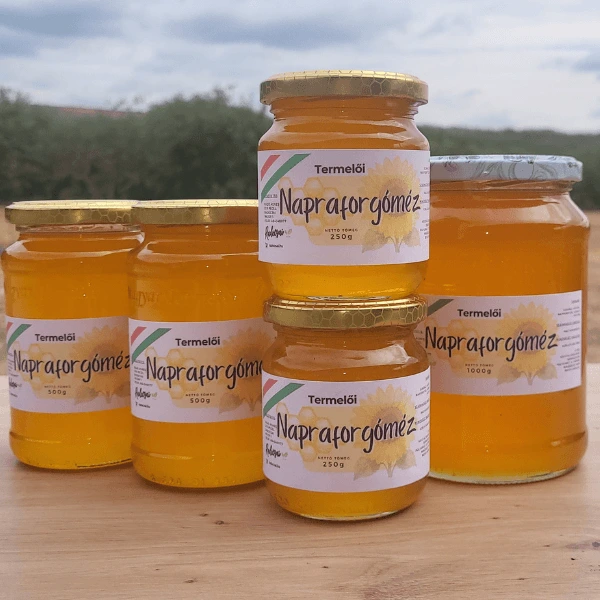
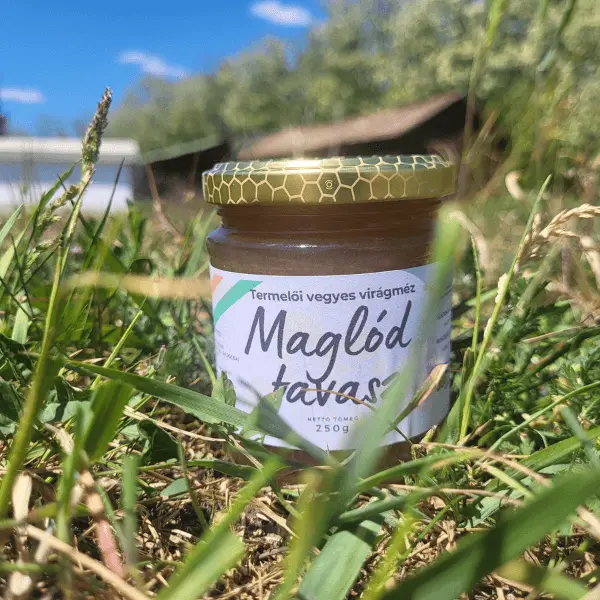
Acacia, sunflower, spring and mixed blossom honey with honeydew, all from our 28 bee colonies in Pécel. You can read about the taste and crystallisation of each type on our honey page.