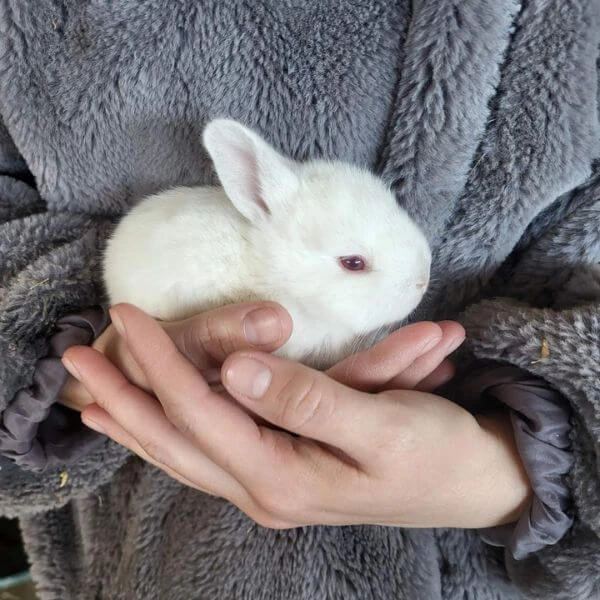
On our farm, we see every day how rabbits live, eat, play and rest. And on farm visits and when people rent our rabbits, we often hear the same questions and myths. Here are the seven most common ones, and the truth about them.
Myth 1
"Rabbits are rodents."
They are not. Rabbits belong to the order of lagomorphs, together with hares and pikas, not to the rodents[1]. They look similar because their incisors grow throughout their lives, but there is a tell-tale difference: behind a rabbit's large upper incisors sits a second, tiny pair of teeth ("peg teeth"), which rodents do not have[1][2]. A rabbit has 28 teeth in total[2].
And while we are on the subject of relatives: the domestic rabbit is a domesticated descendant of the wild European rabbit (Oryctolagus cuniculus), not of the hare seen running across fields, which belongs to a different genus[12]. The European rabbit lives in groups in underground burrows, which is why your rabbit looks for hiding places and company at home too.
Myth 2
"Rabbits live on carrots."
Carrots are a treat, not a main meal. According to the British animal welfare charity RSPCA, about 85% of a rabbit's diet is hay and grass, about 10% leafy greens, and only about 5% pellets. Carrots contain a lot of sugar, so they are for occasional treats only[3]. Carrot tops, however, are a good vegetable. Hay is not only needed for digestion: all that chewing also wears down teeth that keep growing throughout life.

Myth 3
"Rabbits are fine on their own."
They need company. In an Edinburgh experiment, rabbits had to push through weighted doors to reach things: they "worked" almost as hard to be near another rabbit as they did for food[4]. That is why rabbit welfare organisations recommend keeping them at least in pairs[5].
Myth 4
"Rabbits like being picked up and cuddled."
Most rabbits are actually afraid of it. Rabbits are prey animals: in nature, anything that grabs them from above is a predator. According to the House Rabbit Society, this means they instinctively panic when lifted and kick out, and they can hurt themselves or scratch the person holding them[6]. They are much happier if you sit next to them on the floor and let them come to you. If you do have to pick one up, support all four feet and its hindquarters[7], and never lift it by the ears.
Myth 5
"Rabbits are short-lived starter pets."
They are a long-term commitment. A well-kept domestic rabbit lives for 8–12 years on average[8]. According to the House Rabbit Society, this is a commitment of more than ten years, and they recommend rabbits for older children[6]. A rabbit is a lovely companion, but not a "toy" for the children's room. We have written more about this in our article Rabbits and children.
Myth 6
"A small cage is enough."
They want to run. According to the UK Rabbit Welfare Association & Fund (RWAF) and its "A hutch is not enough" campaign, a pair of average-sized rabbits needs a connected space of at least 3 × 2 × 1 metres, where they can not only hop but also run and stand up on their hind legs[9].
Myth 7
"It is a problem if a rabbit eats its own droppings."
It is completely natural, and important too. Rabbits produce two kinds of droppings: the familiar hard, dry pellets, and soft, shiny pellets clustered like grapes (caecotrophs), mainly at night. They eat the latter straight from the bottom, because these are full of protein and B vitamins: this way, they digest their food twice. According to the RSPCA, this is an essential part of their diet[3]. The problem is if a rabbit stops, or if lots of soft droppings are left in the cage: in that case, it is worth seeing a vet.
Quick quiz: true or false?
A rabbit's incisors grow throughout its life.
True A rabbit's teeth have open roots and grow continuously, and chewing hay wears them down[2].
Carrots are the best daily food for a rabbit.
False About 85% of the daily diet is hay and grass, and carrots are a sugary treat[3].
A happy rabbit sometimes jumps in the air and twists.
True All four feet leave the ground, it twists in the air and lands again: this is called a "binky", and it shows joy and excitement[11].
Rabbits are rodents.
False They are lagomorphs, and the second, tiny pair of teeth behind the upper incisors gives them away[1].
Meet our rabbits in person!
On a farm visit, you can hold the rabbits on your lap (with an adult's help), or rent one at any time of year, with two weeks' worth of hay and feed.
Sources
- Grzimek's Animal Life Encyclopedia: Lagomorpha (Pikas, rabbits, and hares). encyclopedia.com
- MSPCA-Angell: Dental Anatomy and Disease of the Domestic Rabbit (Oryctolagus cuniculus). mspca.org
- RSPCA: What to feed your rabbit (the ratio of hay, greens and pellets, carrots, the role of soft droppings). rspca.org.uk
- Seaman S. C., Waran N. K., Mason G., D'Eath R. B.: Animal economics: assessing the motivation of female laboratory rabbits to reach a platform, social contact and food. Animal Behaviour, 2008; 75(1): 31–42. refinementdatabase.org
- RSPCA Australia: Thinking of adopting a bunny? Read this blog. rspca.org.au
- House Rabbit Society: Children and Rabbits. houserabbit.org
- PDSA: How to pick up and hold rabbits. pdsa.org.uk
- Woodgreen Pets Charity: How long do rabbits live? Understanding rabbit lifespan. woodgreen.org.uk
- Rabbit Welfare Association & Fund: Inadequate housing for pet rabbits (A hutch is not enough). rabbitwelfare.co.uk
- UC Davis School of Veterinary Medicine: Litterbox Training Your Rabbit: The Basics (PDF). vetmed.ucdavis.edu
- RSPCA Australia: What does my rabbit's body language mean? kb.rspca.org.au
- Carneiro M. et al.: Rabbit genome analysis reveals a polygenic basis for phenotypic change during domestication. Science, 2014; 345(6200): 1074–1079. doi.org