Quick check at the shelf
- Does it show the country of origin and, for blends, the percentages?
- Are the producer's name and address there?
- Is the price realistic?
- Does the crystallisation suit the honey type?
You are walking through the shop, you take a golden jar off the shelf and you think: "This is it, I'm doing something good for my health." But are you sure you are holding the work of bees, and not a cleverly packaged sugar syrup?
The bad news: you cannot reliably detect fake honey with a home trick. The good news: there are five signs that make you much harder to fool, and you can check most of them while you are still standing at the shelf.
What is fake honey?
Honey counts as adulterated if it is diluted with cheap sugar syrup (such as rice, corn or sugar beet syrup), if it is harvested unripe with a high water content and dried afterwards, or if its true origin is concealed. In the European Commission's coordinated investigation of 2021–22, nearly half (46%) of the honey samples imported into the EU were suspected of containing foreign sugars. Modern syrups are made specifically to pass traditional laboratory tests, so they will certainly not be caught out in your kitchen.
1. Read the label: where does the honey come from?

The label is the most reliable sign, because the seller is legally responsible for what it says.
- Country of origin: since 14 June 2026, EU rules (Directive (EU) 2024/1438) require honey blends to show all countries of origin in descending order, with their percentages. The days of the old, meaningless "blend of EU and non-EU honeys" wording are over.
- Who produced it? Honey from a producer shows the name and address of the beekeeper or farm. If only a commercial brand and a distributor appear, that is not necessarily a problem, but it is not honey directly from a producer.
- Type: honey can only be called acacia, sunflower or linden honey if most of it really comes from that plant. "Blossom honey" or "mixed blossom honey" is made from the nectar of several plants, which is perfectly fine.
2. Suspiciously cheap? Then something is wrong
There is a huge amount of work behind a kilo of honey: caring for, feeding and treating the bee colonies all year round, then extracting and bottling. If a jar of honey costs barely more than sugar, savings had to be made somewhere. The price of honey from a producer typically moves with the size of the harvest from year to year: after a poor acacia bloom, acacia honey costs more too.
3. Is it crystallising? It can still be real, in fact all the more so
Many people think "sugared" honey is fake or has gone off. In fact, crystallisation is the natural behaviour of real honey, and it varies widely by type:
- Sunflower and rapeseed honey: crystallises to a creamy or firm texture within a few weeks.
- Mixed blossom honey: within weeks or months, depending on the mix of flowers.
- Acacia honey: thanks to its high fructose content, it can stay liquid for even a year or two.
What is suspicious: a product sold as sunflower honey that stays liquid for months, or a watery, thin layer separating at the top of a jar. Overheated or heavily filtered honey can also stay liquid for a long time. This is not adulteration, but some of the valuable components of the honey may be lost.
4. Smell it and taste it
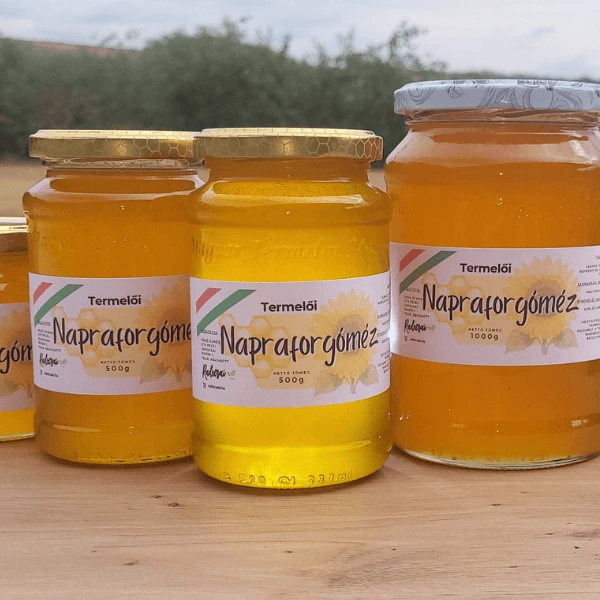
Real single-variety honeys have a distinctive scent and taste: acacia honey is delicately floral, sunflower honey slightly fruity, linden honey fresh and minty, and honeydew honey darker and spicier. If a honey has almost no scent and just tastes sweet, that is not proof of anything, but it is worth asking about.
It is also a good sign if honey differs slightly from year to year: honey from a producer is a natural product, and the weather and the bloom give it a different character each year. A perfectly uniform taste is more likely a sign of large-scale blending.
5. Get to know the beekeeper
The surest sign is not in the honey, but in the person behind it. A beekeeper is happy to tell you where the hives stand, when the honey was extracted and how this year's acacia bloom went. Small producers in Hungary are officially registered, and their name and address are on their products. Buy at farmers' markets, directly from the farm, or go and see where the honey is made.

We are beekeepers like that too
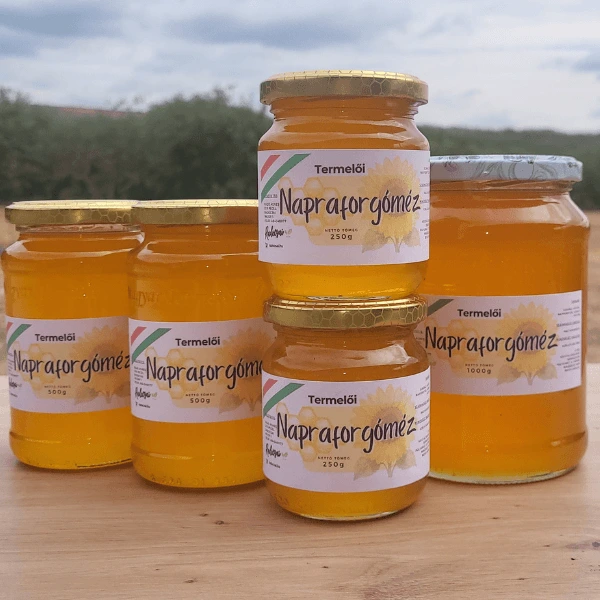
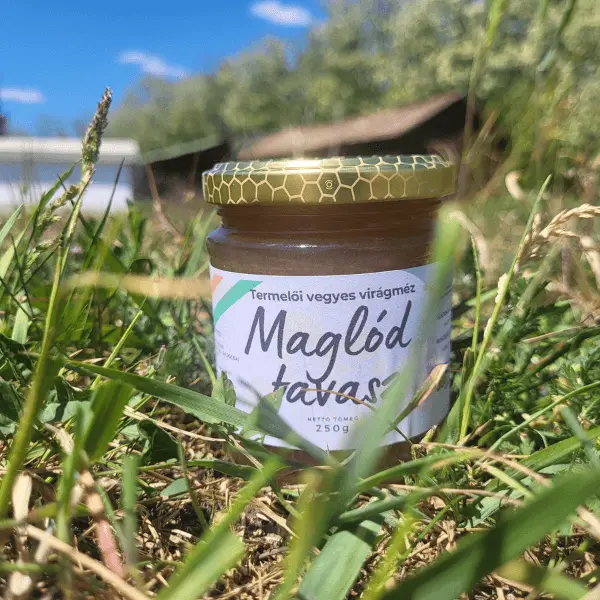
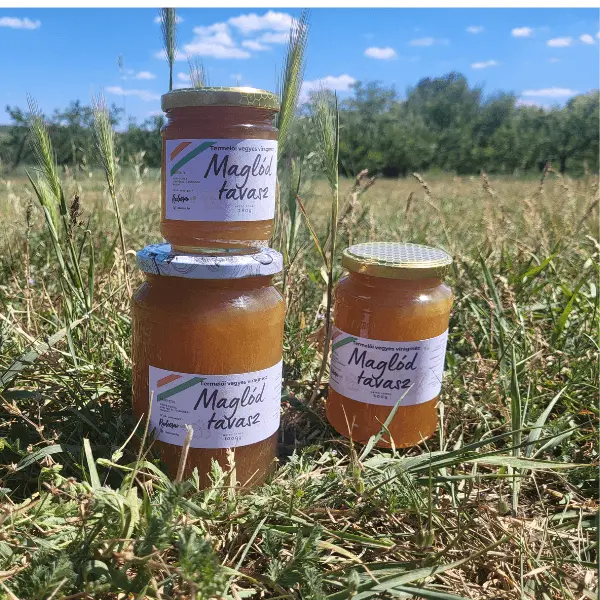
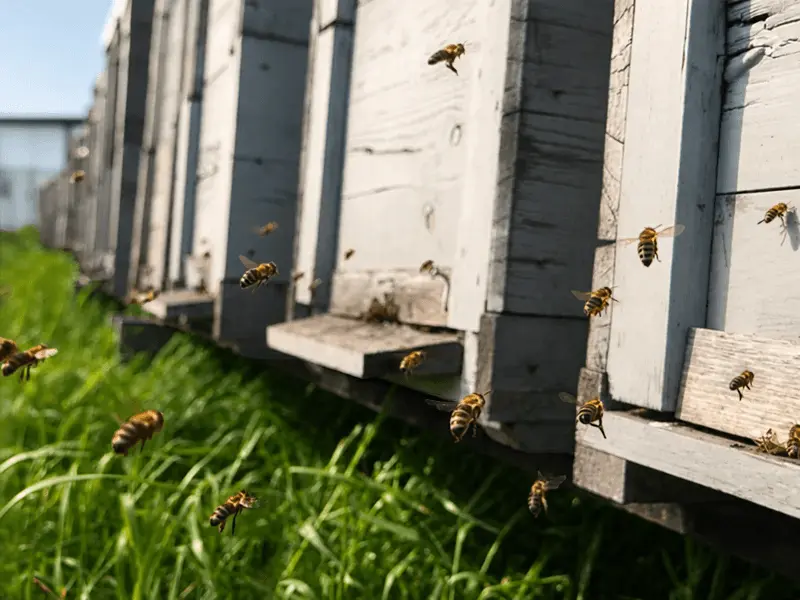
Three generations of our family have kept bees, so when we started in 2023, we were not starting from scratch. Today 28 bee colonies live with us at Radocsai Farm in Pécel. We take the honey from hives we look after ourselves, our name and address are on the label, and we are always happy to tell you which bloom it came from.
Home tricks that sadly do not work
Lots of "home honey tests" circulate online. They look impressive, but none of them proves anything, because well-made fake honey behaves in them just like the real thing:
- Glass of water: both honey and thick sugar syrup sink to the bottom of the glass and dissolve slowly.
- Thumb test: whether a drop spreads depends on the water content and the temperature, not on whether it is real.
- Match or lighter: whether honey burns depends on its water content, and a dried syrup "burns" in just the same way.
- Paper towel, bread, vinegar: these also measure thickness and moisture, not honey.
Adulteration can only be reliably detected by accredited laboratory testing (such as isotope or NMR analysis). As a shopper, the five signs above are therefore your best weapon.
Summary
Check the label and the origin, be suspicious of honey that is too cheap, do not be alarmed by crystallisation, pay attention to scent and taste, and if you can, get to know the beekeeper. Honey from a producer costs more, but you know exactly what you are getting.
Sources: the European Commission's "From the hives" honey investigation (2023); Directive (EU) 2024/1438 on labelling rules for honey.
Our honey
All our 28 bee colonies live at Radocsai Farm in Pécel. Our name and address are on our honey, and you can ask at any time which bloom it came from.
Quick check at the shelf
- Does it show the country of origin and, for blends, the percentages?
- Are the producer's name and address there?
- Is the price realistic?
- Does the crystallisation suit the honey type?